The AI Pyramid: Five Layers Between Hardware and AGI
Disclaimer: The views expressed in this article are my own and do not represent those of my employer. This content was written with the assistance of AI language models but curated and controlled by me.
Most conversations about AI focus on the model. The chatbot, the assistant, the thing that answers your question in seconds. But the model is one layer in a larger stack. Understanding the full stack changes how you think about AI strategy, investment, and what comes next.
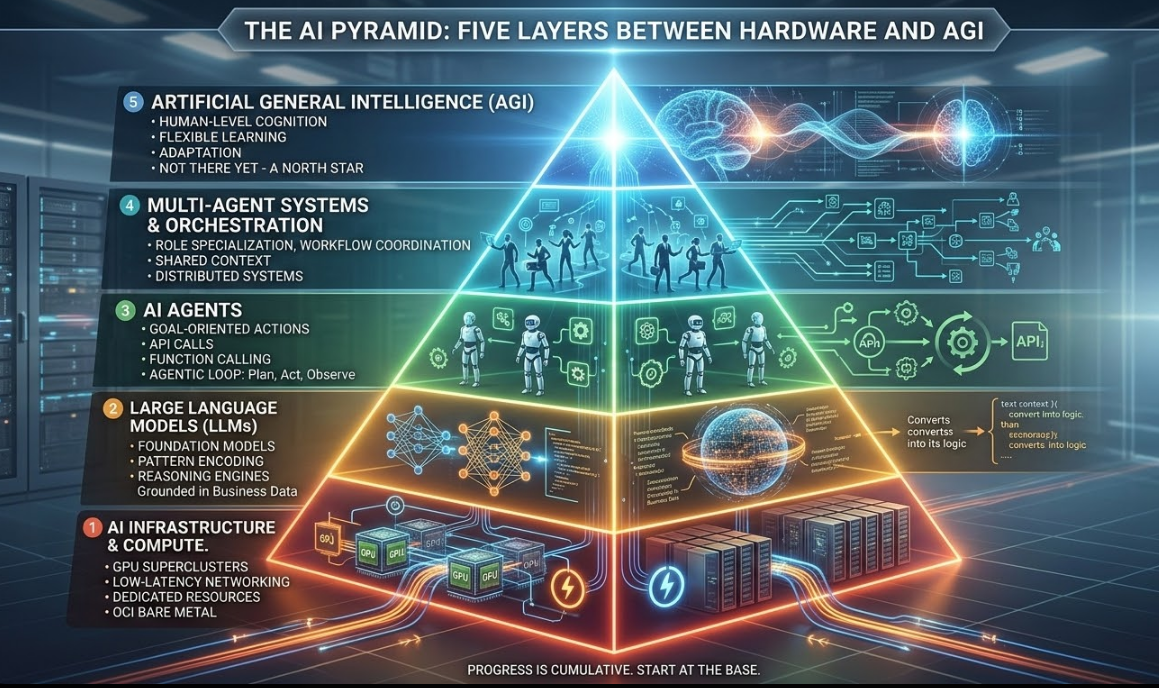
A pyramid is a useful way to frame it. Five layers, each one supporting the layer above. Skip a layer or build it poorly, and everything above it wobbles [1]. The layers are: infrastructure and compute at the base, the large language model above it, then agents, multi-agent orchestration, and artificial general intelligence at the top.
Here is the stack, from the ground up.
The Base: Infrastructure and Compute
Training a large language model takes thousands of GPUs running in parallel for weeks or months. Serving one at production scale takes clusters that handle millions of requests without falling over. This is not a software-only problem. It is a hardware, networking, power, and cooling problem.
Cloud providers own this layer. Oracle Cloud Infrastructure (OCI) has built GPU superclusters designed for AI workloads, with bare-metal instances and RDMA cluster networking that can reduce latency to as little as 2.5 microseconds [2]. OCI’s non-oversubscribed compute model gives customers dedicated resources instead of shared hardware where a neighbor’s workload degrades performance. Deployment options span public cloud, dedicated, and sovereign regions, which matters for organizations where regulation dictates where data and workloads must sit [2].
Infrastructure is not glamorous work. But a training run that fails halfway through wastes millions of dollars. A serving cluster with unpredictable latency makes every layer above it unreliable. The base has to be solid, and there is no shortcut around that.
Layer 1: The Large Language Model
On top of infrastructure sits the model. This is the part most people interact with. You type a prompt, it generates a response. Models like GPT-5.4, Claude, Gemini, and Llama encode patterns learned from massive text datasets and use that knowledge to produce coherent output across a wide range of tasks: summarization, translation, code generation, analysis.
But an LLM in isolation is reactive. It responds to prompts. It does not plan, take action in external systems, or remember what you asked last week unless you feed that context back in. It is a reasoning engine, not an autonomous system.
OCI’s Generative AI Service provides managed access to foundation models with support for chat, text generation, summarization, and embeddings [3]. Enterprises can fine-tune models on proprietary data without that data leaving their tenancy. For organizations that need models grounded in their own business data, Oracle AI Vector Search allows querying by semantics rather than keywords alone, providing a practical path to retrieval-augmented generation [4].
The model layer is where the intelligence lives. But intelligence alone does not get work done.
Layer 2: Agents
An agent takes an LLM and gives it the ability to act. It can call APIs, query databases, execute code, and interact with external systems. Instead of answering questions, it pursues goals. The model advises. The agent executes.
Agents follow a loop: plan, act, observe, adjust. If a database query returns an error, the agent does not stop. It re-evaluates and tries a different approach. This pattern, often called ReAct [5], is becoming the standard way enterprises deploy AI for tasks that go beyond text generation. It introduces new concerns too. Agents need clear permissions, guardrails on what actions they can take, and audit trails for what they did [6].
OCI supports this layer through its Generative AI Agents service [7], a managed framework for building agents that access enterprise data through RAG and function calling. The platform’s identity management, networking, and security controls allow agents to interact with internal systems without opening new attack surfaces.
The shift from “AI that answers” to “AI that does” is happening at this layer.
Layer 3: Multi-Agent Systems and Orchestration
One agent handles a task. Multiple agents, each with a defined role, handle workflows.
In a multi-agent system, you might have a researcher gathering data, a writer drafting content, a reviewer checking quality, and an orchestrator managing the sequence. This mirrors how human teams operate. Specialists coordinate, and the coordination itself is where the value compounds.
The engineering challenges are real. Agents need shared context so they are not working from different assumptions. They need protocols for handoffs and conflict resolution when their outputs disagree. The orchestration layer has to know when to intervene, when to retry, and when to let agents run. Get it wrong and you do not have a smart team. You have distributed confusion with a compute bill.
OCI’s Agent Development Kit supports multi-agent orchestration patterns such as routing, agent-as-a-tool, and deterministic workflows [8]. Oracle also publishes multi-agent RAG solutions on OCI that combine orchestration with Oracle AI Database [9]. The full-stack approach matters here because orchestration is not only an AI problem. It is a systems problem that requires elastic compute, observability, and secure service-to-service communication.
The Top: AGI
Artificial general intelligence sits at the apex. A system that can match or exceed human cognitive ability across domains, not through narrow specialization, but through genuine reasoning, flexible learning, and adaptation to new problems it was never trained on [1].
We are not there. Whether AGI arrives soon, late, or in a form nobody currently expects, it is best treated as a north star rather than as an excuse for hype. Most enterprises do not need AGI to create value today. They need dependable infrastructure, well-chosen models, grounded agents, and orchestrated workflows tied to real outcomes.
The pyramid keeps this conversation honest. Progress toward AGI is cumulative. Weakness anywhere in the stack limits what the layers above can achieve.
Why This Matters
The pyramid is a practical lens for thinking about where to invest.
If your infrastructure is unreliable, your agents will be unreliable. If you have model access but no agent strategy, you are using AI as a search engine when it could be a workforce. If you are building single agents without thinking about orchestration, you will hit a wall when you try to coordinate them on complex problems.
The pyramid also works as a filter for hype. When someone claims AGI is around the corner, ask whether they have solved multi-agent coordination. Ask whether their agents handle failures gracefully. Ask whether their infrastructure can sustain the load. The layers tell the story.
Do not start your AI strategy at the top of the pyramid. Start at the bottom and climb. The work is bottom-up. It always has been.
References
- Google DeepMind, “Taking a responsible path to AGI,” deepmind.google/blog/taking-a-responsible-path-to-agi
- Oracle, “AI Infrastructure,” oracle.com/ai-infrastructure
- Oracle, “Overview of Generative AI Service,” docs.oracle.com/en-us/iaas/Content/generative-ai/overview.htm
- Oracle, “Overview of Oracle AI Vector Search,” docs.oracle.com/en/database/oracle/oracle-database/23/vecse/overview-ai-vector-search.html
- Yao, S. et al., “ReAct: Synergizing Reasoning and Acting in Language Models,” ICLR 2023
- U.S. Federal Register, “Request for Information Regarding Security Considerations for Artificial Intelligence Agents,” federalregister.gov/documents/2026/01/08/2026-00206
- Oracle, “Generative AI Agents,” docs.oracle.com/en-us/iaas/Content/generative-ai-agents/home.htm
- Oracle, “OCI Agent Development Kit,” docs.oracle.com/iaas/Content/generative-ai-agents/adk/api-reference/introduction.htm
- Oracle, “Build a Multiagent RAG Solution on OCI,” oracle.com/artificial-intelligence/build-multiagent-rag-solution-on-oci