A Reckoning With Cost: Memorial Day, Leadership, and the Standard AI Won't Set for You
1,718 words · 9 min read
Disclaimer: This post reflects my personal views and does not represent the views of my employer or my community.
Caveat: This was written with research assistance from AI tools, but I curated the content, edited the draft, and cross-checked the references.
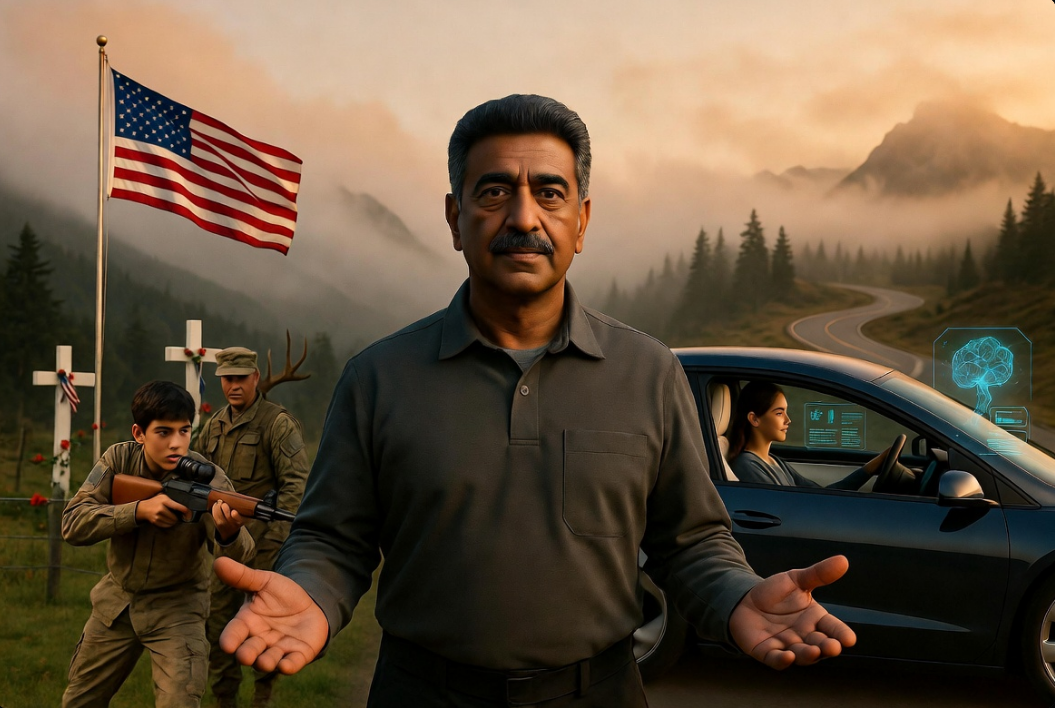
Image: The illustration above was generated with Grok.
This weekend, I did two things that seemed unrelated but shared a deeper connection. I took my son to an elk farm in the mountains of Washington, where an old Army buddy of mine let us shoot. The next day, I sat in the passenger seat of my wife’s Tesla on a winding road outside Whistler, my hands resting in my lap while my daughter drove with real consequences on either side of the lane for the first time.
The experiences felt different at first, guiding my son to handle a rifle on the farm and, the next day, watching my daughter learn to trust a car on winding roads. But reflecting on both, I realized they shared a common thread. In each moment, my role was not to be the center of the story, but to create the conditions for someone else to become capable. That parallel has led me to a new understanding: that is what leadership actually is.
Leadership is not the performance of confidence. It is the transfer of responsibility.
And on Memorial Day, that idea sorta of cemented inside my mind and i decided to write an article on the theme.
What We Actually Remember
Memorial Day is not a celebration of war. It is a reckoning with cost [11]. The men and women we honor today didn’t die advancing their careers or building a personal brand. They didn’t manage their visibility or shape a narrative. They confronted injustice in places most of us will never see, for people they would never meet, and a great many of them paid for it with everything they had.
That is a specific kind of leadership: the kind that puts others so far first that the self disappears entirely.
If we forget why we remember them, the holiday becomes a long weekend with flags in the background. If we remember clearly, it becomes a standard. And the standard asks one direct question:
What kind of leadership is worthy of the sacrifice we claim to honor?
That question doesn’t only matter inside the military. It ALSO matters in companies, engineering teams, communities, and families. It matters more right now because AI is handing leaders more leverage than they have ever had, and leverage is not the same thing as wisdom.
The Three Leaders You’ll Meet, and How to Survive Them
Leadership literature has wrestled with this for decades: Greenleaf on servant leadership [1], Collins on Level 5 [2][3], Sinek on the leaders who eat last [4], and cautionary field guides like Snakes in Suits [5]. Different frameworks, same center of gravity: the best leaders use their authority to make people stronger, not to feed their own ambition.
Three archetypes show up again and again. They are not three points on a single spectrum of “selfishness.” They are three different operating systems, each one wanting something different. That difference is what determines everything else they do.
1. The Narcissistic Leader: wants admiration. [6] The room is a mirror. They evaluate every conversation, every win, and every decision against a single question: does this make me look like the singular force behind it? Vision may be real, but it always points back at them. Their primary tool is charisma; their currency is attention.
- The tell, in a crisis: The question is “who made me look bad?”, never “what did we learn?” Credit travels up. Blame travels down. Loyalty is rewarded over candor, and the people around them quietly stop saying hard, true things.
- How to deal with them: Document everything. Build trusted relationships outside their orbit so your reputation doesn’t depend on their goodwill. Don’t compete for the spotlight; that game is rigged. Separate the mission from the theater. When the exposure cost gets too high, leave; long stretches under this style of leadership change what a team believes is normal.
2. The Political Leader: wants position. [5][7] The room is a chessboard. Every move is a hedge, calibrated to protect their seat at the table. They are not driven by ego; they are driven by survival and advancement inside whatever system they sit in. Their primary tool is leverage: coalitions, information, timing. Their currency is positioning. Unlike the narcissist, they often don’t need to be seen; they need to be safe.
- The tell, in a crisis: When the right decision is costly, they don’t commit. They wait to see which direction the room is moving and then align with it. Their alliances shift with the wind. A genuine crisis somehow never turns out to be their turn to carry weight, and accountability is always something that lives in a slightly different org.
- How to deal with them: Anchor every conversation to the mission, the customer, and the measurable outcome. Make decision rights visible, in writing, so positions can’t be quietly walked back later. Don’t confuse proximity with sponsorship. And don’t let their behavior teach you cynicism; cynicism feels protective, but it quietly lowers your own standard.
3. The Great Leader: wants outcomes that outlast them. [1][2][3][8][9][10] The room is a workshop. Authority is a tool for making other people stronger, and they spend it that way on purpose. They are not necessarily quiet or humble in personality; Level 5 leaders can be sharp, demanding, and intensely competitive. What sets them apart is direction: their ambition points at the work and the team, not at themselves. Their primary tool is clarity and trust; their currency is capability built in other people.
- The tell, in a crisis: The question is “what did we learn, and how do I shield the team while we fix it?” They give credit away. They absorb blame. They surface the problem early, not after it’s safely deniable. Weak leaders create dependency. Great leaders create capacity, and you can see it most clearly in their absence, when what they built keeps running without them.
- How to deal with them: Learn from them. Bring them problems early. Tell them the truth, especially when it’s uncomfortable. Don’t waste their investment in you. And when you’re ready, copy the pattern; become the kind of person who makes others stronger without needing to own their success.
A clean way to keep them straight: the narcissist looks in the mirror, the politician reads the room, the great leader watches the team. Same situation, three different places their eyes go first, and that first look decides everything that follows.
AI Doesn’t Create Leaders. It Reveals Them.
Here is where I want to be direct, because I work in AI and GPU infrastructure (for the last nine years) and cloud/software for the last twenty, and I watch this play out every day. AI is not a leadership style. It is leverage (a glorified tool). And leverage compounds whatever direction you’re already pointed.
Hand a narcissistic leader a suite of generative tools and they get a sharper megaphone: more polished messaging, the ability to seem everywhere at once, an engine for spinning narratives and looking data-driven while ducking real accountability. The manipulation doesn’t get louder. It gets more efficient.
Hand a political leader the same tools and the maneuvering accelerates. Sentiment analysis and influence-mapping become instruments for deciding who to elevate and who to sideline based on positioning rather than performance.
But hand those exact tools to a great leader and something else entirely happens. They use AI to strip friction out of the work, get better information into the team’s hands faster, scale mentorship across people they could never previously reach, and clear the drudgery so humans can do the parts that require a human. The servant instinct simply finds more surfaces to act on. The technology is neutral however he character wielding it is not.
And here is what AI still cannot do, no matter how good the next model gets [12][13]:
AI can recommend a strategy. It cannot absorb the consequences. AI can draft a difficult message. It cannot stand in front of the team and carry the weight of it. AI can surface risks. It cannot choose courage. AI can simulate tradeoffs. It cannot love the people affected by the decision.
That last line may sound too soft for tech or business. I don’t think it is. Care is not the opposite of performance; it’s often what makes sustained performance possible. People will work hard for a leader they trust. They will take risks for a mission that matters. They will endure difficulty when they believe the burden is being carried honestly [4][9]. You cannot generate trust with a prompt. You can only spend down the trust you’ve already built.
The Through Line
My Army buddy doesn’t say much about what he did in service. He owns a farm, he keeps his word, and he spent a Saturday teaching my kid something useful and lethal with total patience. That’s the whole thing, right there. The soldiers we remember today had no personal-brand strategy. They had a commitment to something larger than themselves, and they paid it at the highest possible cost.
My son learned this weekend that a rifle demands respect and restraint, that real power is mostly about the discipline not to use it carelessly. My daughter learned that even the smartest car still needs a present, thoughtful driver who keeps both hands ready. The next generation is watching how we handle power, whether it shows up as a firearm, an electric vehicle, or an artificial intelligence that will happily do whatever we point it at. So this week, before you reach for the next AI tool, ask three honest questions:
- Are you building systems that amplify clarity and mentorship, or confusion and self-promotion?
- Are you leading like the people we remember today, who put others first, or are you optimizing for how you look?
- When AI hands you a suggestion, do you still ask: does this serve the mission and the people, or just me?
AI will keep on reshaping how we work, communicate, and decide. It will not resolve the oldest question in leadership.
Who are you actually doing this for?
That one is still on us.
To everyone who served, and to the families who carry their legacy, thank you. Your example is still the clearest definition of leadership we have: not status, but service. The hardest, highest form of it.
References
The three archetypes above aren’t original to me. They’re a working synthesis drawn from a long tradition of leadership writing, and from a smaller, sharper tradition of writing about leadership gone wrong. If any of this resonated, these are the sources worth your time:
- Robert K. Greenleaf, The Servant as Leader (essay, 1970) and Servant Leadership: A Journey into the Nature of Legitimate Power and Greatness (1977). The foundational case for leadership as service, the lens this article ultimately runs on.
- Jim Collins, Good to Great: Why Some Companies Make the Leap… and Others Don’t (2001). Origin of the Level 5 Leader framework, the combination of personal humility with fierce professional will that the “Great Leader” archetype draws from.
- Jim Collins, “Level 5 Leadership: The Triumph of Humility and Fierce Resolve,” Harvard Business Review (January 2001). The shorter, sharper version of the same idea, if you don’t want to read the whole book.
- Simon Sinek, Leaders Eat Last: Why Some Teams Pull Together and Others Don’t (2014). On why people will work hard, take risks, and endure difficulty for leaders they trust, and the biological and organizational reasons that trust is built or broken.
- Paul Babiak & Robert D. Hare, Snakes in Suits: When Psychopaths Go to Work (2006; revised edition 2019). The most rigorous field guide to recognizing and surviving destructive leaders inside organizations. Source for the behavioral patterns described under the narcissistic and political archetypes.
- Michael Maccoby, “Narcissistic Leaders: The Incredible Pros, the Inevitable Cons,” Harvard Business Review (January 2004, originally published 2000). The clearest short treatment of what productive and destructive narcissism look like at the top of an organization. Direct backing for the “mirror” archetype.
- Jeffrey Pfeffer, Power: Why Some People Have It, and Others Don’t (2010). A clear-eyed account of how positional and political behavior actually works inside organizations. Useful background for the “chessboard” archetype, regardless of whether you find the prescriptions appealing.
- Liz Wiseman, Multipliers: How the Best Leaders Make Everyone Smarter (2010; revised 2017). Direct support for the claim that great leaders create capacity in others rather than dependency on themselves, the operating signature of the “workshop” archetype.
- Jocko Willink & Leif Babin, Extreme Ownership: How U.S. Navy SEALs Lead and Win (2015). On the practical mechanics of taking responsibility, and on why ownership, not blame management, is the actual leadership skill.
- Peter F. Drucker, The Effective Executive (1967). The original, still unmatched, treatment of leadership as a discipline of contribution rather than a question of personality.
- U.S. Department of Veterans Affairs, “Memorial Day History,” Office of Public and Intergovernmental Affairs. Background on the holiday’s origins as Decoration Day after the Civil War and its evolution into the modern observance referenced at the top of this piece.
- Stuart Russell, Human Compatible: Artificial Intelligence and the Problem of Control (2019). On the limits of AI autonomy and what humans must keep in their own hands.
- Ethan Mollick, Co-Intelligence: Living and Working with AI (2024). On working alongside AI as a collaborator rather than a replacement, and how character shapes the partnership.
For the AI-and-leadership thread, most of what I argue here is field observation rather than citation. Anyone wrestling with these questions seriously should also read references [12] and [13] above.